For Greenland, the unimaginable is now on the table
Seemingly unthinkable at the end of 2025, an invasion of Greenland is no longer far-fetched in this new and highly kinetic new year.
When the White House’s 2025 National Security Strategy was released in November, many northerners were puzzled by the omission of the Arctic from the document. There was no Arctic section, in contrast to the previous NSS document in 2022, and no mention at all of Greenland, which has featured so prominently (and controversially) in President Trump’s vision of an expanded American hemispheric power.
Like a North Atlantic iceberg, Greenland had drifted off the global media’s radar in recent months, as other places and events dominated headlines — from the ongoing military conflicts in Gaza and Ukraine to the new year’s showdown in Venezuela.
Then in late December, the media spotlight shone brightly once again on the world’s largest island.

Royal Danish Defence College associate professor Marc Jacobsen said on LinkedIn that he didn’t expect the U.S. to use military force to take control of Greenland because “it would be catastrophic — effectively marking the end of NATO and any remaining credibility of U.S. commitments to international law.” He added: “It would also put an end to any peace prize ambitions Donald Trump may hold.”
But after America’s successful lightning strike on Venezuela last weekend, and the abruptness of Trump’s pivot to Greenland in the hours and days that have followed, it is unclear whether there are influential actors in the President’s inner circle who are willing — or even interested — in stopping such an idea.
Given the deep moral injustices in past Danish colonial policies in Greenland and the continued suffering that resulted (as I described here at Arctic Today), one can now envision a confluence of humanitarian intervention, commercial interests (particularly rare earths and uranium), and national security aligning as they did in Venezuela, providing justification for another forceful implementation of the Trump Doctrine.
But not all voices favor a military solution for Greenland. President Trump’s appointment of Louisiana Governor Jeff Landry as his special envoy to Greenland could inject new energy and much-needed civility to the diplomatic dispute between America and Denmark over Greenland. Indeed, Governor Landry’s appointment could be perceived as a voice of peace, given that his home state of Louisiana is rich in symbolic and historic significance of a non-military nature.

As Landry himself has observed, this is because of Louisiana’s heritage as one of America’s largest and peaceful territorial expansions, via the Louisiana Purchase of 1803. As reported in The Hill,
“Look, the United States has always been a welcoming party, he said in an interview with The Hill. “We don’t go in there trying to conquer anybody and trying to – you know – take over anybody’s country. We say, ‘Listen, we represent liberty, we represent economic strength, we represent protection.”
As Arctic geopolitical expert Klaus Dodds wrote on LinkedIn: “While it is common for commentators to talk about the Trump Corollary to the Monroe Doctrine, I would focus on another analogy that you will see with current U.S. posture towards Greenland. Why, you might ask, was the Governor for Louisiana asked to act as special envoy to Greenland? One answer might be that the potential acquisition of Greenland has been compared by some to the 19th century Louisiana Purchase – in territorial size at least.
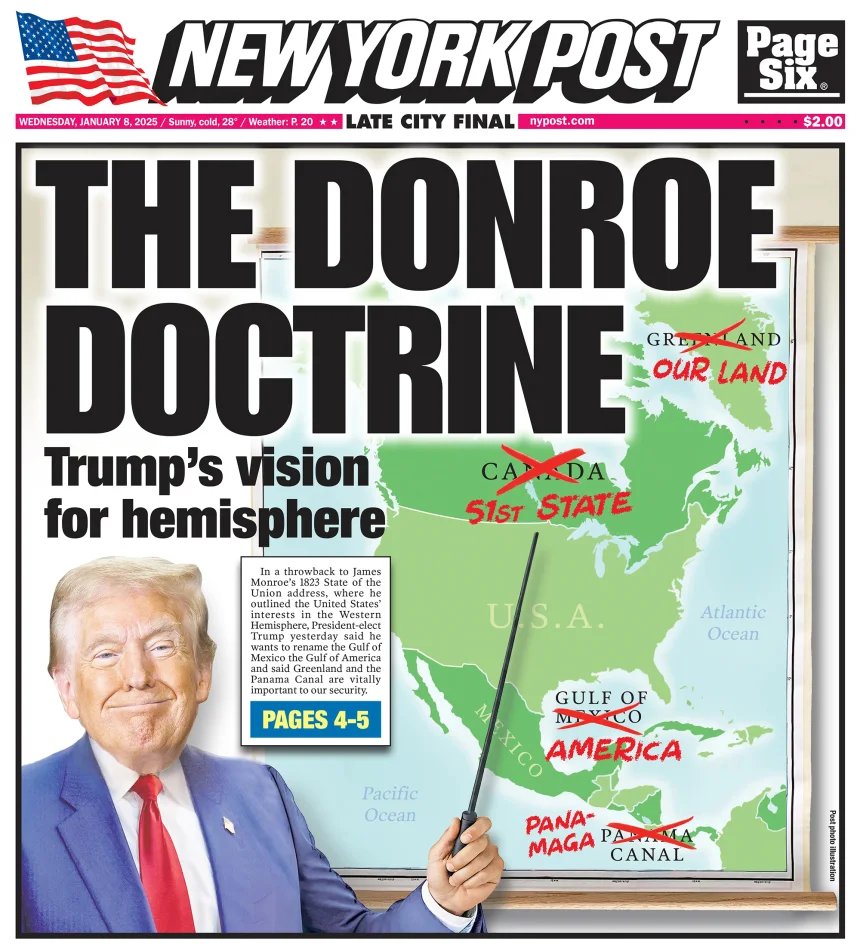
But after America’s strike on Venezuela, few observers were talking about the Louisiana Purchase as a model for Greenland’s constitutional future. Indeed, the conversation had shifted at the White House in the aftermath of the Maduro snatch-and-grab, when confidence in the newly asserted Trump Doctrine was at a zenith. Trump himself described his application of the Monroe Doctrine as the “Donroe Doctrine,” borrowing this colorful term from a prescient January 8, 2025 front page of the New York Post.
The headlines have been dramatic, from the BBC (“‘We need Greenland’: Trump repeats threat to annex Danish territory”) to the Guardian (“US attack on Greenland would mean end of Nato, says Danish PM” and CNBC (“Denmark in ‘crisis mode’ as Trump sets sights on Greenland after Venezuela attack”). As CNBC reported, Trump told the press on Sunday aboard Air Force One: “We need Greenland from the standpoint of national security and Denmark is not going to be able to do it, I can tell you.”
Iconic image
If a picture is worth a thousand words, a now iconic image widely circulated from the X account of Katie Miller, wife of Trump’s Deputy Chief of Staff Stephen Miller (a leading architect of Trump’s aggressive Venezuela policy), portrayed a map of Greenland superimposed by the Red, White and Blue with the ominous (to Denmark) caption, “SOON” in all caps. The image has since been reposted all around the world.
“The days have long since passed that such images can be simply laughed off,” geopolitical analyst Klaus Dodds said on LinkedIn. No doubt few in Denmark and Greenland will forget President Trump remarking last year that the U.S. would acquire Greenland one way or another.”
Soon after his wife’s controversial X posting, Deputy Chief of Staff Stephen Miller doubled down on America’s right to possess Greenland in a fiery interview with Jake Tapper on CNN’s The Lead. Noting Greenland’s small population (and getting it wrong by half), Miller wrote: “The real question is… what right does Denmark assert control over Greenland? What is the basis of [its] territorial claim?”
“For the United States to secure the Arctic region to protect and defend NATO and NATO interests, obviously, Greenland should be part of the United States,” Miller said. “We live in a world… that is governed by strength, that is governed by force, that is governed by power. These are the iron laws of the world.”
Since the first Trump administration the government’s formal position has been that Greenland should be part of the U.S. Miller told Tapper.
When Tapper pressed Miller on the potential use of force, Miller replied: “There’s no need to even think or talk about this in the context that you’re asking of a military operation. Nobody’s gonna fight the United States militarily over the future of Greenland.”
So far, political leaders in Greenland continue to insist the island is not for sale. That doesn’t appear to be deterring Trump.
But as CNN reported, the “US. will take Greenland the ‘hard way’ if it can’t do it the ‘easy way,’ Trump says.” Never one to mince his words, President Trump told the ABC News, “We are going to do something on Greenland whether they like it or not.”
President Trump may see no option but to send his armada next to Greenland, and take by force what he cannot get through negotiation – just as he did in Venezuela only a few short days ago. Whether that will actually happen may become clearer after U.S. Secretary of State Marco Rubio meets with Danish officials this week.
Barry Scott Zellen is a Research Scholar in the Department of Geography at the University of Connecticut and a Senior Fellow (Arctic Security) at the Institute of the North. He is the author of “Arctic Exceptionalism: Cooperation in a Contested World.”